The Sequence That Shaped Everything
Yevgeny Zamyatin completed We in 1920 or 1921 — the manuscript circulated in the Soviet Union as samizdat, hand-copied and passed between readers, but no Russian publisher would touch it. The novel's vision of a totalitarian single state, its citizens stripped of names and given numbers, was too direct a satire of the revolutionary order to survive any editorial committee. Glavlit, the Soviet censorship authority, never needed to suppress a printed edition; none was submitted.
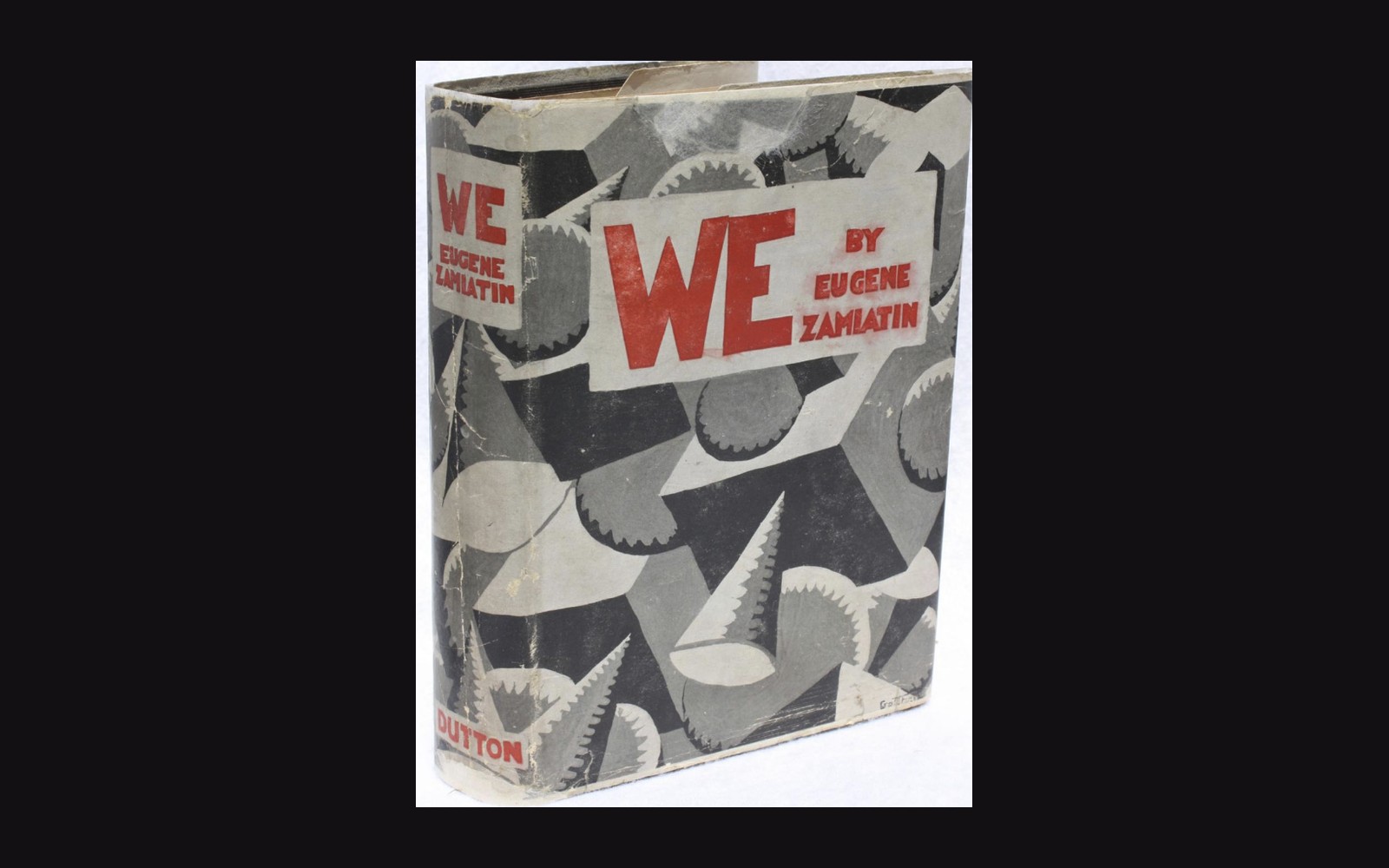
What appeared instead was an English translation. Gregori Zilboorg rendered the novel into English, and E. P. Dutton published it in New York in 1924 — making it, by years, the first edition of We in any language. A Czech translation appeared in 1927. The first Russian-language edition did not appear until 1952, published in New York by the Chekhov Publishing House. Soviet readers had no legal access to the novel until the glasnost era; We was finally published in the USSR in 1988, in the thick journal Znamya.

The 1924 Zilboorg translation remained the standard English text for decades, despite the distance between its idiom and later critical expectations. It carries the novel's letter-and-number designation system and its geometry of glass walls and marching citizens intact, but translators and critics have since noted its tendency toward period smoothing that softens Zamyatin's syntactic strangeness.
Clarence Brown's translation, published by Penguin in 1993, and Natasha Randall's for Modern Library in 2006 both represent retranslations aimed at restoring that abrasiveness. Randall's version has drawn the most sustained attention for keeping the narrator D-503's voice unstable and mathematically obsessive. A 2021 scholarly overview of the novel's translation history traces how each version has inflected the relationship between We and its acknowledged descendants — Aldous Huxley's Brave New World and George Orwell's Nineteen Eighty-Four, both of which appeared after Zamyatin's manuscript had already circulated in Europe.
The publishing sequence itself carries an argument: We entered world literature in English, not Russian, and remained inaccessible to most of the readers it described for sixty-four years.