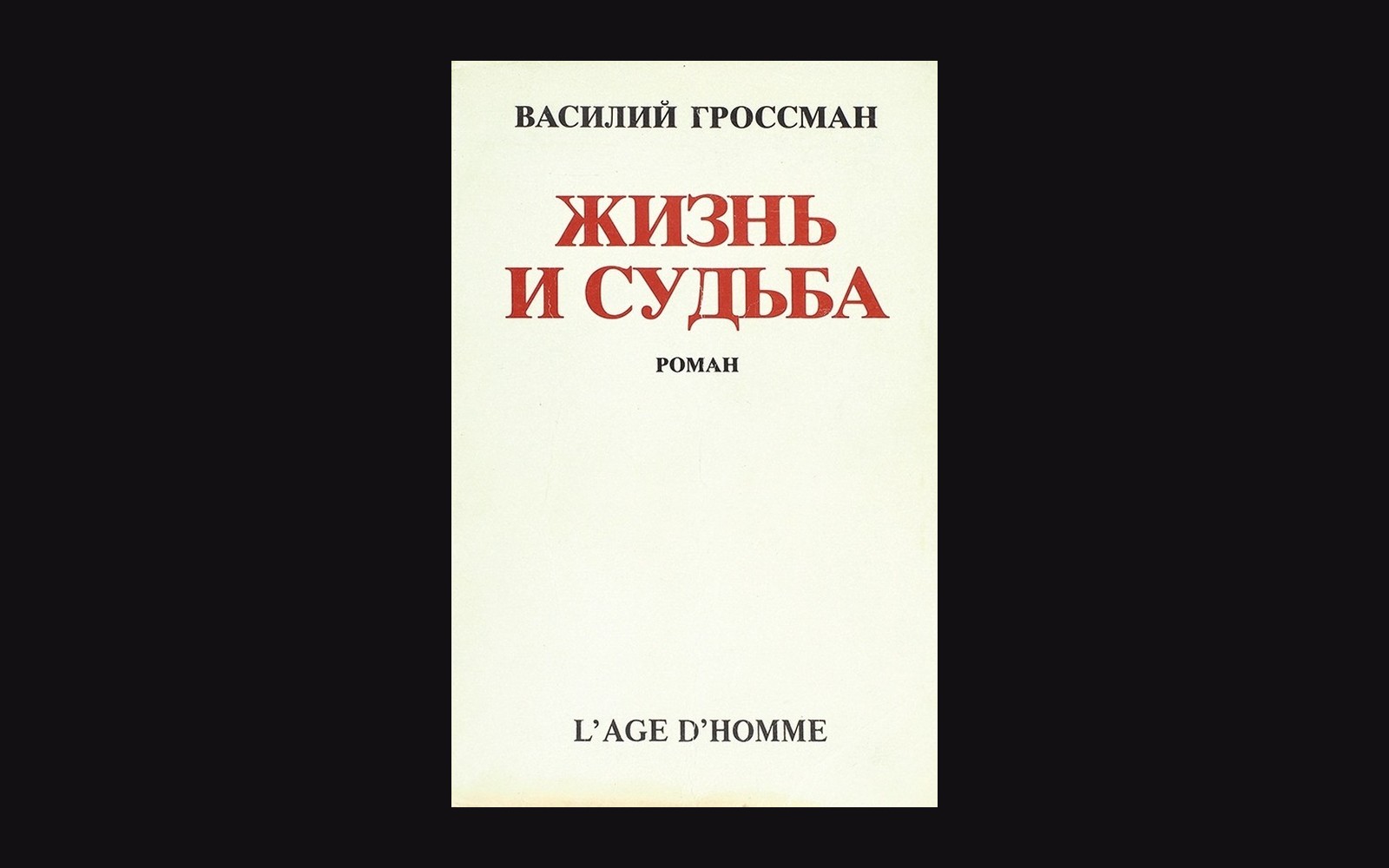
The manuscript that reached print
Vasily Grossman completed Life and Fate around 1960. The KGB confiscated the manuscript in 1961 — seizing copies, carbon papers, and ribbon — in what amounted to an arrest of a book rather than its author. A surviving copy, preserved by friends, was microfilmed and eventually passed to the West. The Russian-language text appeared in 1980 from L'Âge d'Homme in Lausanne, nearly two decades after the seizure, and sixteen years after Grossman's death in 1964.
The English translation followed five years later. Published in 1985 by Collins Harvill in the United Kingdom and by Harper & Row in the United States, it was the work of Robert Chandler — a translation he would later revise substantially, but whose first appearance put the novel before Anglophone readers for the first time. That 1985 edition carried an introduction by the military historian John Erickson, situating the novel's account of Stalingrad and the Soviet rear within the historiography of the Eastern Front.
The Chandler revisions and their scope
Chandler's relationship with Life and Fate has been unusually prolonged. The 1985 translation was followed by a significantly revised edition published by NYRB Classics in 2006, which brought the English text into closer alignment with Grossman's Russian — adjusting register, restoring elided passages, and reworking a number of key scenes. NYRB Classics' edition, which remains the standard text in North American and British markets, also carries a new introduction and has kept the novel continuously in print for nearly twenty years.
The 2006 revision reflects a broader development in how literary translation has been understood since the 1980s: greater fidelity to source-language rhythm and syntax is now more consistently expected, and translators are more likely to revisit earlier work when norms have shifted. Chandler has spoken and written extensively about the difficulties Grossman poses — his work on Grossman and Andrei Platonov addresses both writers' resistance to conventional literary smoothness, and the specific problem of translating a prose that is deliberately uneven.
The book's critical standing
For its first decade in English, Life and Fate circulated primarily among readers of Soviet history and comparative literature. The comparison with Tolstoy's War and Peace — inevitable given the novel's scale, its two-family structure, and its battlefield scope — was made early and often, but it took time for Grossman to enter general literary conversation in the Anglophone world rather than specialist discussion.
That shift accelerated in the 2000s and 2010s, partly through the NYRB Classics reissue and partly through a broader reevaluation of twentieth-century Russian prose. A BBC Radio 4 serialisation of Life and Fate in 2011, adapted by Mike Walker and broadcast across twelve episodes, reached an audience well outside the novel's existing readership and prompted a measurable increase in sales of the Chandler translation in the United Kingdom. It is now commonly placed alongside The Master and Margarita, Doctor Zhivago, and One Day in the Life of Ivan Denisovich as a canonical work of Soviet-era fiction in English translation — a position it did not hold at all in 1985.
The novel's subject matter — the moral equivalence it draws between Nazi and Soviet systems of terror, and its portrayal of individual conscience under totalitarianism — ensures that its critical framing continues to shift with political circumstance. Since February 2022, interest in the novel in Western universities and libraries appears to have grown, as readers and academics reach for historical fiction that addresses the Soviet past at scale. The book's tamizdat history, its four decades of English availability, and Chandler's two-version translation record make it one of the most fully documented cases of a suppressed Soviet text finding its permanent Anglophone form.